The Problem That Created a Field
In 1994, mathematician Peter Shor published an algorithm that could, in theory, factor large integers and solve the discrete logarithm problem in polynomial time on a quantum computer. That paper did not immediately threaten anything: the most powerful quantum computers of the time had fewer than ten coherent qubits and could not run Shor's algorithm on inputs of any practical size. But cryptographers recognized the implication immediately. Every public-key cryptographic system in widespread use, RSA, elliptic-curve cryptography, and Diffie-Hellman key exchange, derives its security from one of these two problems. A sufficiently large, fault-tolerant quantum computer would break all of them.
The field of post-quantum cryptography exists to answer a single question: what mathematical problems are hard for both classical and quantum computers? After nearly three decades of research and an eight-year formal evaluation process, that question now has a rigorous, standardized answer.
For blockchain specifically, the stakes are unusually high. Unlike encrypted database records that become unreadable when a key is lost, blockchain transactions are public and permanent. Anyone storing today's blockchain traffic can decrypt it the moment a cryptographically relevant quantum computer exists. This is the harvest-now, decrypt-later threat, and it is already being executed by sophisticated state-level adversaries.
What Post-Quantum Cryptography Actually Means
Post-quantum cryptography (PQC) refers to classical algorithms, ones that run on today's hardware, whose security does not depend on the hardness of integer factorization or discrete logarithms. The label is forward-looking: these algorithms are designed to remain secure after large-scale quantum computers exist, not after they have already broken everything else.
This is a critical distinction. PQC is not quantum cryptography, which refers to physically quantum systems like quantum key distribution (QKD). PQC runs on standard CPUs and GPUs, requires no specialized hardware, and can be deployed in software on existing infrastructure. The mathematical foundations are different; the deployment model is familiar.
The threat model has two components. Shor's algorithm, run on a fault-tolerant quantum computer with enough logical qubits, breaks asymmetric cryptography: the public-key schemes used for digital signatures and key exchange. Grover's algorithm provides a quadratic speedup for searching, which halves the effective security level of symmetric schemes and hash functions. The practical implication: AES-128 becomes roughly equivalent to AES-64 against a quantum adversary, and SHA-256 retains approximately 128 bits of pre-image resistance. Symmetric schemes survive by doubling key lengths. Asymmetric schemes require entirely new mathematical foundations.
NIST's Eight-Year Standardization Process
In December 2016, the U.S. National Institute of Standards and Technology issued a call for proposals for post-quantum cryptographic algorithms. The competition drew 69 submissions from research teams worldwide. Over three rounds of public evaluation, the pool narrowed to a handful of finalists and alternates, each scrutinized by the global cryptographic community for mathematical soundness, implementation security, performance, and resistance to side-channel attacks.
The evaluation criteria were demanding. NIST required candidates to provide formal security proofs, reference implementations, and detailed performance benchmarks across a range of hardware platforms. Submissions that survived multiple rounds faced concentrated cryptanalysis from hundreds of independent researchers, some of whom found flaws that eliminated previously strong candidates. SIKE, a supersingular isogeny-based scheme that reached the fourth round as an alternate, was completely broken in 2022 by a classical attack requiring only a few hours on a laptop. Its elimination underscored why the process needed to be long, public, and adversarial.
In August 2024, NIST published three final standards: FIPS 203 (ML-KEM, based on CRYSTALS-Kyber), FIPS 204 (ML-DSA, based on CRYSTALS-Dilithium), and FIPS 205 (SLH-DSA, based on SPHINCS+). A fourth standard, FN-DSA based on FALCON, was finalized shortly after. These four algorithms now represent the global baseline for post-quantum security.
The Four Selected Algorithms
CRYSTALS-Kyber (ML-KEM, FIPS 203)
Kyber is a key encapsulation mechanism, not a signature scheme. Its role is to replace Diffie-Hellman: it allows two parties to establish a shared secret over an insecure channel without having previously exchanged keys. Kyber's security derives from the Module Learning With Errors (M-LWE) problem, a structured variant of LWE that enables compact key sizes while maintaining strong security guarantees.
Kyber public keys run approximately 800 bytes to 1.6 KB depending on the security level, and ciphertexts are similarly compact. This makes Kyber practical for TLS handshakes, encrypted messaging protocols, and the kind of channel-to-channel communication that a multi-architecture blockchain like QuanChain performs millions of times per day.
CRYSTALS-Dilithium (ML-DSA, FIPS 204)
Dilithium is the primary post-quantum signature standard. Where ECDSA derives its security from the elliptic-curve discrete logarithm problem, Dilithium derives its security from Module-LWE and Module-SIS, two problems with no known efficient quantum algorithm. A Dilithium-2 public key is approximately 1.3 KB; a Dilithium-5 signature (the highest security level, comparable to AES-256) is approximately 4.6 KB. By comparison, an ECDSA signature is 64 bytes.
That size difference is not trivial for blockchain applications. A network processing hundreds of thousands of transactions per second, each carrying a 4.6 KB signature rather than a 64-byte one, faces a roughly 70-fold increase in signature data volume. This is one reason why algorithm selection alone does not solve the blockchain quantum migration problem: the entire stack, from block size limits to network propagation to storage, must be redesigned around the new constraints.
FALCON (FN-DSA)
FALCON is a lattice-based signature scheme built on NTRU lattices rather than the module lattices underlying Dilithium. Its primary advantage is signature compactness: FALCON-512 signatures are approximately 690 bytes, and FALCON-1024 signatures are approximately 1.3 KB, substantially smaller than their Dilithium counterparts.
The tradeoff is implementation complexity. FALCON's signing algorithm requires high-precision floating-point arithmetic and careful handling of a discrete Gaussian sampler. A flawed implementation can leak the private key through timing side channels. NIST standardized FALCON specifically for applications where bandwidth efficiency is critical, while recommending Dilithium as the default for most use cases due to its simpler, more robust implementation profile. For blockchain validators handling high-throughput signing, the implementation risk is a serious consideration that must be weighed against the bandwidth savings.
SPHINCS+ (SLH-DSA, FIPS 205)
SPHINCS+ is the outlier in the NIST portfolio. Where Kyber, Dilithium, and FALCON all rely on lattice-based hardness assumptions, SPHINCS+ makes no algebraic assumptions at all. Its security reduces entirely to the collision resistance and pre-image resistance of an underlying hash function, typically SHA-256 or SHAKE-256. If those hash functions remain secure (as they are expected to, even against Grover's algorithm at appropriate bit lengths), SPHINCS+ remains secure.
This mathematical independence is SPHINCS+'s core value proposition. If lattice-based cryptography were to be broken by a future mathematical breakthrough, SPHINCS+ would be unaffected. The cost is signature size: SPHINCS+ signatures range from approximately 8 KB (fast parameter sets) to 50 KB (small parameter sets optimized for compact signatures at the cost of signing time). For most blockchain transaction types, this makes SPHINCS+ impractical as a sole signature scheme but extremely valuable as a redundant second layer.
Lattice-Based vs. Hash-Based vs. Code-Based Approaches
The three main families of post-quantum cryptography differ in the mathematical problems they rely on, their performance characteristics, and the maturity of their security analyses.
Lattice-based schemes offer the best overall balance of key size, signature size, and performance. The underlying problems, shortest vector problem (SVP) and learning with errors (LWE), have been studied extensively since the 1990s and have resisted both classical and quantum attack. The main uncertainty is that these schemes are younger than RSA or ECC: they have had years of cryptanalysis rather than decades. Parameter recommendations have been adjusted multiple times as understanding of the best classical attacks improved.
Hash-based schemes like SPHINCS+ are the most conservative choice. Hash functions have been battle-tested for longer than any other cryptographic primitive, and the security reductions for hash-based signatures are tight and well-understood. The disadvantage is performance: SPHINCS+ signing can be 100 to 1,000 times slower than ECDSA, and signatures are orders of magnitude larger. For a blockchain, this matters.
Code-based schemes like Classic McEliece are the oldest post-quantum candidates, with McEliece's original 1978 proposal remaining unbroken for nearly fifty years. Their security is extremely well-established. The problem is key size: McEliece public keys can reach several megabytes, making them impractical for most blockchain applications. They are valuable for high-security, low-bandwidth scenarios where key exchange happens rarely and storage is not a constraint.
Signature Sizes and Performance Tradeoffs
The numbers matter. A concrete comparison of signature and key sizes across schemes illustrates the engineering challenge facing any blockchain migrating to post-quantum security:
- ECDSA (P-256): 64-byte signature, 33-byte public key
- EdDSA (Ed25519): 64-byte signature, 32-byte public key
- CRYSTALS-Dilithium-3: 3.3 KB signature, 1.9 KB public key
- CRYSTALS-Dilithium-5: 4.6 KB signature, 2.6 KB public key
- FALCON-512: 690-byte signature, 897-byte public key
- FALCON-1024: 1.3 KB signature, 1.8 KB public key
- SPHINCS+-256f: 49 KB signature, 64-byte public key
Performance diverges similarly. On modern hardware, ECDSA verification runs in microseconds. Dilithium verification is slower by a factor of roughly three to five; SPHINCS+ verification is slower by a factor of ten or more depending on the parameter set. For a blockchain node verifying thousands of transactions per second, this overhead is not negligible, and it compounds when composite schemes are used.
The blockchain quantum migration problem is not just a question of swapping one signature scheme for another. It requires rethinking block structure, mempool limits, network gossip protocols, and storage architecture, all while maintaining backward compatibility or orchestrating a coordinated migration that does not strand existing users.
Why Algorithm Selection Alone Is Not Enough
Selecting the right algorithm is necessary but insufficient. Several additional factors determine whether a PQC deployment actually provides the intended security guarantees.
Hybrid and composite schemes. During a transition period, systems that support both classical and post-quantum algorithms need to ensure that the combination does not introduce new attack surfaces. A hybrid TLS handshake that combines X25519 and Kyber is secure if either component is secure, but the session key derivation must be designed so that an attacker who breaks one component gains nothing. Composite signatures that require both Dilithium and SPHINCS+ to verify provide defense in depth: breaking the composite requires simultaneously defeating two mathematically independent schemes.
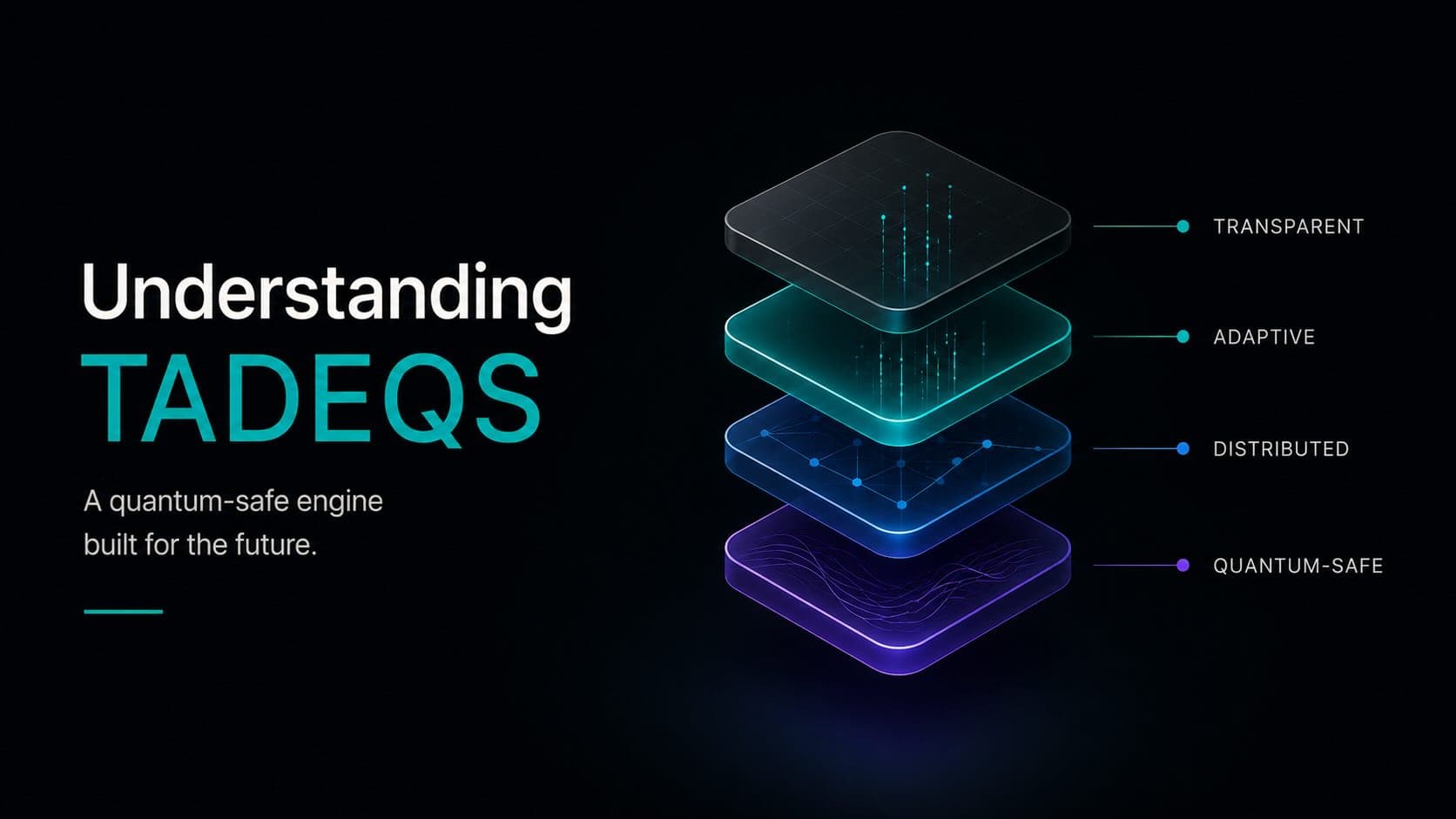
Key management and rotation. Post-quantum keys are larger and slower to process. Systems that assumed millisecond key generation and byte-sized key storage need to be updated. More importantly, long-lived keys are a particular liability: a key that exists today can be harvested and attacked once quantum computers mature. Frequent key rotation, ideally tied to each transaction as in QuanChain's TADEQS architecture, dramatically reduces the window of exposure.
Implementation security. FALCON's Gaussian sampler is not the only implementation hazard in the PQC ecosystem. Side-channel attacks, timing attacks, and fault injection attacks can extract private keys from correct implementations of correct algorithms. Constant-time implementation is a requirement, not an optimization.
Algorithm agility. Cryptographic history is full of schemes that seemed secure until they were not. A system that hard-codes a single PQC algorithm and requires a fork or a full protocol upgrade to change it is one mathematical breakthrough away from catastrophe. The Quantum Oracle in QuanChain's architecture exists precisely to enable dynamic response to changes in the threat landscape, including the ability to migrate algorithm parameters or schemes without requiring user action.
PQC Deployment in Blockchain
Most existing blockchains were not designed with post-quantum migration in mind. Bitcoin uses ECDSA; Ethereum uses ECDSA and EdDSA. Their address formats encode public key hashes, which provides some protection against Shor's algorithm for unspent outputs whose public keys have never been revealed. But the moment a user spends from an address, the public key is exposed in the transaction, and from that point a quantum adversary can attempt to derive the private key. Approximately four million Bitcoin are held in addresses whose public keys are already exposed.
For a survey of which networks are most exposed, see our analysis of which cryptocurrencies are most vulnerable to quantum attacks. The short answer: any network using ECDSA or EdDSA with reused or exposed public keys is at risk once a sufficiently powerful quantum computer exists.
A truly quantum-resistant blockchain requires more than replacing the signature scheme. It requires rethinking address derivation so public keys are never exposed, building key rotation into the transaction protocol so no key is ever used twice, implementing composite PQC signatures for defense in depth, and creating governance mechanisms for algorithm agility that do not require emergency hard forks under adversarial conditions.
QuanChain's implementation combines Dilithium-5 and SPHINCS+-256f in a composite signature scheme: both signatures must verify for a transaction to be accepted. The Three-Channel Architecture distributes the computational overhead of PQC verification across purpose-built execution environments, and the Proof of Coherence consensus mechanism creates direct financial incentives for validators to maintain quantum-hardened infrastructure rather than cutting corners on cryptographic overhead.
The Timeline Question
The most common objection to immediate PQC migration is that large-scale quantum computers do not yet exist. This is true. It is also beside the point for two reasons.
First, harvest-now, decrypt-later attacks are already underway. Sensitive data encrypted today with classical algorithms is being stored by adversaries who expect to decrypt it once quantum hardware matures. For blockchain transactions, this means every transaction broadcast today on a classical network is a permanent record that will be decryptable in the future. The migration cannot wait until Q-Day to be useful; it needs to happen before the data becomes valuable to decrypt.
Second, migration takes time. The history of cryptographic transitions suggests that deploying new algorithms across a major ecosystem takes five to fifteen years. SSL 3.0 was deprecated in 2015 and is still encountered in the wild. SHA-1 was formally deprecated by NIST in 2011 and remained in widespread use through 2017. A blockchain with thousands of nodes, tens of millions of users, and billions of dollars in value cannot migrate overnight. The consequences of waiting for Q-Day to begin are severe.
To assess your own exposure, QuanChain's Quantum Threat Calculator provides a structured framework for evaluating timeline risk against asset value and migration cost.
What Comes Next
NIST's 2024 standards are not the end of PQC research. Several additional candidates remain under evaluation, including code-based KEMs and isogeny-based schemes that may offer advantages for specific use cases. The field continues to evolve: new attacks are published regularly, parameter recommendations are updated, and implementation guidance improves as deployment experience accumulates.
For blockchain specifically, the next frontier is not algorithm selection but ecosystem integration: developer tooling that abstracts PQC complexity, wallet standards that support post-quantum key derivation, cross-chain interoperability protocols that work with larger key and signature sizes, and governance frameworks that enable proactive algorithm migration rather than reactive emergency response.
The properties of a quantum-resistant blockchain go well beyond the signature scheme. They encompass the full cryptographic stack, the operational architecture, and the governance mechanisms that determine how the system responds when the threat landscape changes. Algorithm selection is where the conversation starts, not where it ends.
Post-quantum cryptography is not a destination. It is a practice: a commitment to building systems that remain secure not just against today's adversaries with today's tools, but against tomorrow's adversaries with tools that do not yet exist.
For a closer look at how specific blockchain networks stack up, see our comparison of quantum-resistant blockchains versus traditional blockchains, and our roundup of the top quantum-resistant crypto projects in 2026.