The "Quantum Washing" Problem
The blockchain industry has a quantum washing problem. Projects add a single post-quantum signature algorithm to their transaction layer, update their documentation to include the phrase "quantum resistant," and stop there. The rest of the architecture: wallet key management, validator signing, state finality, historical chain data, remains entirely classical and entirely vulnerable.
This is not quantum resistance. It is a narrow improvement to one component of a multi-component system, marketed as a complete solution. The distinction matters because adversaries do not restrict themselves to the one component that has been upgraded. They attack the weakest link, and in a quantum-washed blockchain, there are four remaining weak links.
Genuine quantum resistance requires five specific architectural properties. A blockchain that satisfies all five can legitimately claim the label. One that satisfies fewer cannot, regardless of which algorithms appear in its specification. Understanding what quantum resistance actually requires starts with understanding these five properties and why each is non-negotiable.
Most blockchains today satisfy zero of them.
Property 1: No Public Key Exposure On-Chain, Ever
This is the property that classical blockchains structurally cannot satisfy for any address with a transaction history, and it is the one that post-quantum signature upgrades cannot fix retroactively.
On Bitcoin, Ethereum, and virtually every classical chain, spending from an address requires publishing the corresponding public key as part of the transaction. That public key is then permanently recorded in the immutable ledger. Shor's algorithm takes a public key and derives the private key in polynomial time on a fault-tolerant quantum computer. Every address that has ever sent a transaction on a classical chain has therefore handed a quantum adversary exactly the input needed to steal its funds, and that data cannot be unarchived.
The harvest-now-decrypt-later attack exploits this directly: sophisticated adversaries are archiving blockchain transaction histories today, collecting every exposed public key across every major chain, to be processed once capable quantum hardware is available. The attack does not require being present when quantum computers arrive; it requires only that the data collection happened before them.
A quantum resistant blockchain must be architected so that the public key is never published on-chain at any point. TADEQS achieves this through a parent/child key structure where spending is authorized through a commitment scheme that reveals nothing about the underlying key material. Atomic SpendAndRotate key rotation ensures that every spend simultaneously updates the key commitment, leaving no static target for an adversary to archive. The full mechanics of this architecture represent a departure from the address model that all major classical chains use.
Property 2: NIST-Standardized Post-Quantum Signatures for All Authorization
Transaction authorization must use a signature scheme whose security holds against quantum attack. The NIST post-quantum standardization process, which concluded in 2024 after eight years of public cryptanalysis, selected three signature standards: CRYSTALS-Dilithium (ML-DSA), FALCON (FN-DSA), and SPHINCS+ (SLH-DSA). These standards are the result of the most rigorous cryptographic evaluation process ever applied to post-quantum algorithms. They have earned a level of trust that homegrown or non-standardized schemes cannot claim.
The emphasis on "NIST-standardized" is not bureaucratic pedantry. Cryptographic algorithm security is not established by design claims or internal analysis; it is established by years of public cryptanalysis by independent researchers with adversarial incentives. An algorithm that has not gone through this process may have subtle flaws that are not apparent to its designers. Several candidates submitted to the NIST process were broken during evaluation, including algorithms that appeared sound on initial review. The ones that survived are the ones to use.
Any blockchain claiming quantum resistance that uses a non-standard, homegrown, or novel post-quantum algorithm is accepting unknown cryptographic risk. That risk is incompatible with genuine quantum resistance, which requires not just algorithmic novelty but verified security.
Additionally, the word "all" matters: authorization at every layer must use PQC. A chain that uses Dilithium for user transactions but still uses ECDSA for validator attestations is not a quantum resistant blockchain; it is a chain with a quantum-resistant user layer and a classically vulnerable consensus layer.
Property 3: Adaptive Security That Responds to the Evolving Threat
Quantum hardware capability is not a fixed quantity. Logical qubit counts are rising, error correction overhead is falling, and algorithmic improvements continue to reduce the resource requirements for running Shor's algorithm against real-world key sizes. The qubit threshold required to break Bitcoin's cryptography has been revised downward repeatedly as the field advances. Any security guarantee expressed in terms of "current hardware cannot execute this attack" has an unknown expiration date.
A blockchain whose cryptographic parameters are fixed at deployment is therefore making a time-bounded security guarantee of unknown duration. When that duration expires, the chain's security model changes with no mechanism for the network to respond. Users have no warning, and there is no automatic adaptation.
Genuine quantum resistance requires a mechanism to monitor the evolution of quantum hardware capability and adjust security parameters accordingly. The Quantum Oracle continuously tracks LQCp/h (Logical Qubit Cost per Hour) and feeds that signal into a dual-path cost model evaluating both Grover-class and Shor-class attack economics. When the model determines that attack economics are crossing predefined thresholds, the network triggers an automatic escalation of its cryptographic parameters through a three-tier migration system that requires no user action and no hard fork.
This property transforms quantum resistance from a static snapshot into a living posture that remains valid as the threat evolves.
Property 4: Quantum-Hardened Consensus Infrastructure
Transaction-layer post-quantum security is meaningless if the consensus layer is classically vulnerable. Validators produce and attest to blocks using cryptographic signing keys. If those keys use ECDSA or EdDSA, a quantum adversary can forge validator attestations, impersonate any validator in the set, and subvert block production without controlling any meaningful stake or hashrate. The entire economic security model of proof-of-stake fails if validator identities can be forged.
A quantum resistant blockchain requires that validator signing, block attestation, and all consensus-layer cryptographic operations use the same class of post-quantum algorithms applied to the transaction layer. This is not optional and it is not a future upgrade path; it must be true from genesis, because consensus data is archived just like transaction data, and historical validator signing keys exposed on-chain are subject to the same harvest-now-decrypt-later attack as user public keys.
Proof of Coherence addresses this by combining quantum-resistant validator signing with a stake/performance split that allocates 50% of validator influence to stake weight and 50% to performance metrics. Validators operating certified quantum-hardened infrastructure receive additional rewards, creating a direct financial incentive for the network to maintain the consensus-layer security posture that genuine quantum resistance requires. The full design of Proof of Coherence reflects a consensus architecture built around quantum resistance as a first-class constraint.
Property 5: Long-Range State Integrity Against Quantum-Enabled Reorg Attacks
The fifth property is the least discussed and arguably the most underappreciated. Chain finality on both proof-of-work and proof-of-stake networks ultimately rests on cryptographic assumptions. A sufficiently capable quantum adversary could potentially use their ability to forge signatures and solve classical computational problems quickly to attempt long-range reorg attacks against historical chain state. The economic and cryptographic bar for such an attack is high but not infinite, and it decreases as quantum hardware improves.
Protecting against this requires that the integrity of historical chain state be anchored to something more than one chain's own security model. The Cross-Chain Referential Points (CCRP) protocol addresses this by anchoring state commitments to Bitcoin, Ethereum, and Solana at regular intervals. Rewriting QuanChain's history requires simultaneously defeating four independent security models across four independent networks, a requirement that places the attack outside the practical reach of any realistic quantum adversary.
This property extends the quantum resistance guarantee from "new transactions are secure" to "all historical chain state is secure," which is the complete security guarantee a blockchain's users actually need.
A Scoring Framework for Evaluating Quantum Resistance Claims
Every blockchain claiming quantum resistance can be evaluated against these five properties with a simple yes/no assessment at each criterion.
- Property 1 (No public key exposure): Does the protocol spend mechanism ever publish a public key on-chain? A yes here means any address with transaction history is vulnerable.
- Property 2 (NIST-standardized PQC for all authorization): Are all signatures, including validator and consensus-layer signatures, using ML-DSA, FN-DSA, or SLH-DSA? A partial yes (user transactions only) does not satisfy this property.
- Property 3 (Adaptive security): Does the network have a live mechanism that monitors quantum hardware capability and automatically adjusts cryptographic parameters? A migration plan that requires a hard fork does not satisfy this property.
- Property 4 (Quantum-hardened consensus): Are validator signing keys and block attestations protected by PQC? Does the protocol provide economic incentives for quantum-hardened validator infrastructure?
- Property 5 (State integrity anchoring): Is historical chain state integrity anchored to external security models that remain valid even if the chain's own cryptographic assumptions are compromised?
What the Major Chains Actually Score
Applying this framework honestly to the major chains yields uncomfortable results, but the analysis is straightforward.
Bitcoin: 0/5. Bitcoin uses ECDSA for all transaction signing, exposes public keys at every spend, has no PQC roadmap with a concrete activation mechanism, uses classical signing throughout its consensus layer, and has no external state anchoring. Bitcoin's developers are aware of the quantum threat and have discussed various mitigation approaches, but no changes are in the activation pipeline. Bitcoin's fixed-parameter design makes Property 3 structurally inapplicable without a hard fork.
Ethereum: 0/5. Ethereum uses ECDSA for externally owned accounts, exposes public keys at transaction time, and despite active research into account abstraction and PQC integration, has not deployed any of these changes to mainnet. The Ethereum Foundation has acknowledged the quantum risk and EIPs related to quantum migration exist, but deployment timelines are measured in years and historical exposure cannot be resolved retroactively. Ethereum also scores 0 on consensus-layer PQC, adaptive security, and state anchoring.
The honest assessment is not that these are bad networks; it is that they were designed before quantum resistance was an engineering requirement, and retrofitting that property onto chains with years of public key exposure history is a deeply constrained problem. The full analysis of which cryptocurrencies are most exposed shows the scope of the problem across the broader landscape.
What a 5/5 Architecture Looks Like
A blockchain that satisfies all five properties must have been designed around quantum resistance from genesis. Retroactive compliance is not possible for Properties 1 and 5 on any chain with existing transaction history, and retrofitting Property 3 requires architectural components that most classical chains do not include.
The 5/5 architecture: never publishes public keys on-chain, uses NIST-standardized PQC for every signing operation including consensus, runs a live adaptive security system that responds to quantum hardware developments, provides economic incentives for quantum-hardened validator infrastructure, and anchors historical state integrity to multiple external security models. Each property is implemented at the protocol layer, not as an optional feature or a future upgrade path.
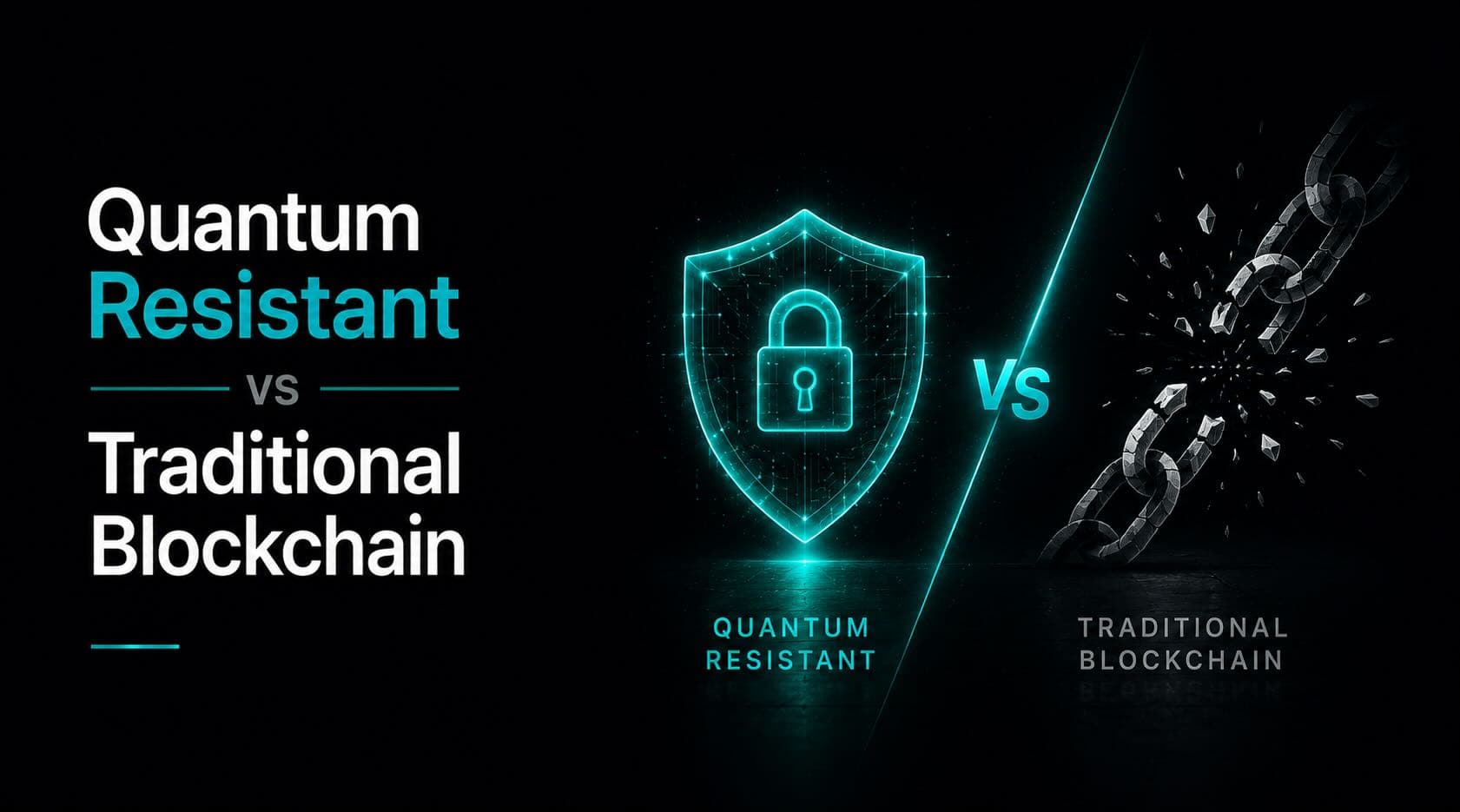
The difference between a quantum resistant blockchain and a quantum-washed one is not which algorithms appear in the specification. It is whether every attack surface a quantum computer can exploit has been addressed at the architectural level, with no exceptions.
That is the only standard worth applying when the stakes are the long-term security of financial infrastructure. Use the quantum threat calculator to estimate your own exposure window, and check which wallet types are currently most at risk.