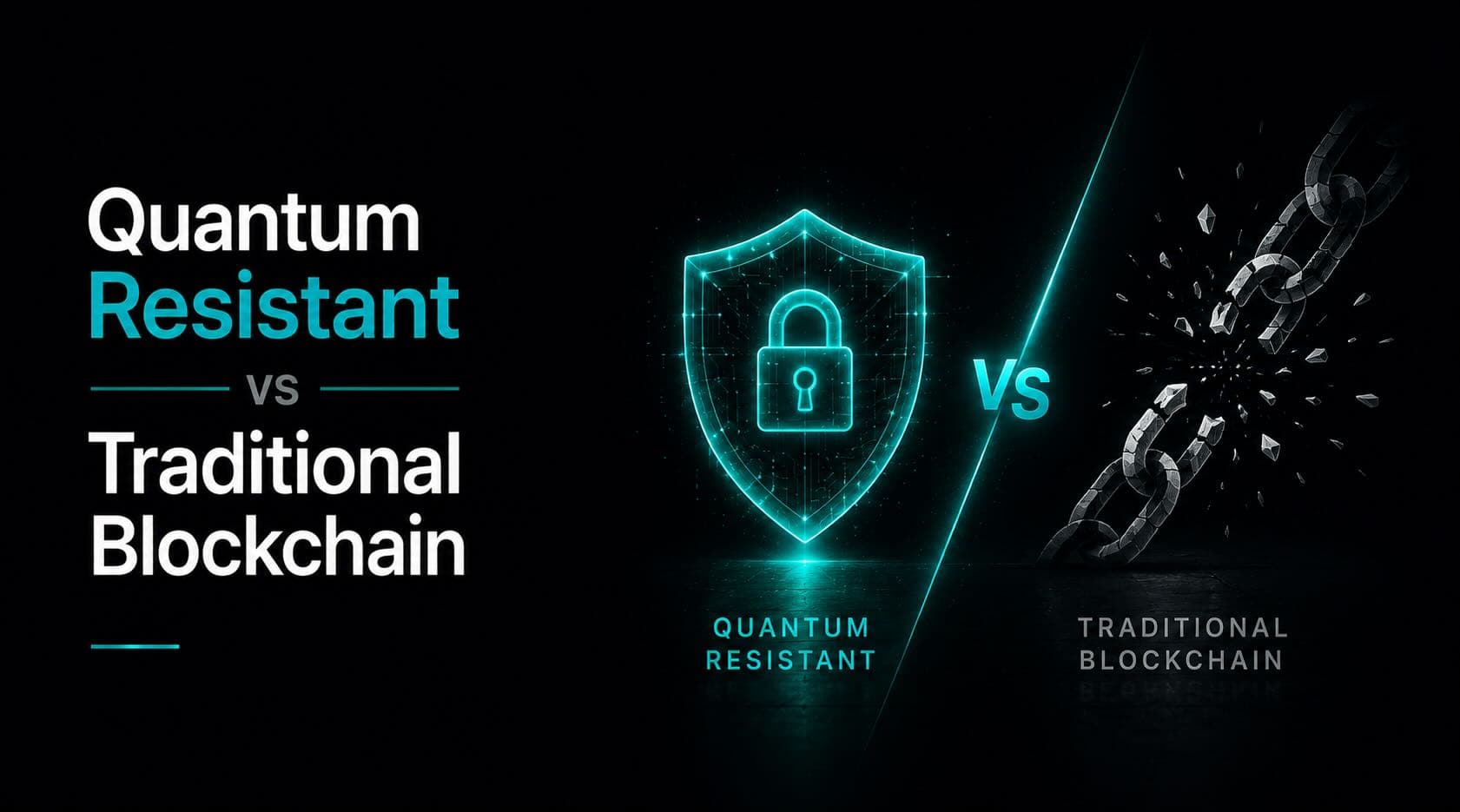
The Design Choice That Changes Everything
The most important question in quantum-resistant blockchain design is not "which post-quantum algorithm should we use?" It is "are we retrofitting quantum resistance onto a classical architecture, or designing for it from genesis?"
That distinction produces two fundamentally different systems. A traditional blockchain with a post-quantum signature upgrade is still a traditional blockchain in every structural sense: its wallet model, address scheme, consensus design, and threat response posture are all inherited from an architecture that was never designed to resist quantum attack. A genuine quantum resistant blockchain, built from the ground up with quantum resistance as a first-class constraint, looks different at every layer. The differences are not cosmetic. They affect how wallets work, how transactions are sized and routed, how validators are incentivized, and how the network responds when quantum hardware advances.
This post maps those differences layer by layer.
Wallet Architecture: Public Key Exposure vs Permanent Key Privacy
Every classical blockchain wallet operates on the same basic model: a private key generates a public key, the public key generates an address, and spending from that address requires signing with the private key and publishing the public key to prove ownership. This model is efficient and simple. It is also structurally incompatible with quantum resistance.
When you spend from a Bitcoin or Ethereum address, your public key is published on-chain. From that point forward, it is permanently archived in a distributed ledger held by thousands of nodes worldwide. Shor's algorithm takes a public key and derives the private key in polynomial time on a fault-tolerant quantum computer. Every address that has ever sent a transaction is therefore a future target.
A quantum resistant blockchain designed from scratch eliminates this exposure entirely. TADEQS implements a parent/child key architecture where spending is authorized through commitment schemes that never reveal the underlying key material to the ledger. The SpendAndRotate mechanism atomically rotates the key commitment at every spend, ensuring there is no persistent public key target at any point in the address's history. The mechanics of TADEQS also implement 20 graduated security tiers, scaling the cryptographic parameters of each transaction to the value at risk. A small daily payment uses efficient, lighter parameters; a large institutional transfer uses the highest security tier available. Traditional blockchains apply the same cryptographic parameters to every transaction regardless of value.
Transaction Signatures: ECDSA vs NIST Post-Quantum Standards
Classical blockchains use ECDSA or EdDSA for transaction signing. Both rely on the elliptic-curve discrete logarithm problem, which Shor's algorithm solves efficiently. The signature sizes are small: an ECDSA signature is 64 bytes, and the corresponding public key is 32 to 64 bytes. These compact sizes contribute to the transaction throughput characteristics classical chains are optimized for.
NIST post-quantum signature standards are larger. A CRYSTALS-Dilithium signature at the standard security level is approximately 2,400 bytes, and a FALCON-512 signature is approximately 660 bytes, with public keys of similar or greater size. Naively replacing ECDSA with Dilithium increases signature data by roughly 37 to 50 times, with compounding effects on transaction size, block capacity, and network propagation. This is the principal engineering challenge in building a performant quantum resistant blockchain.
The size overhead is real and must be addressed at the architectural level, not treated as an acceptable cost. Simply substituting PQC signatures into a classical blockchain design produces a chain with dramatically reduced throughput and higher fees, which is not a viable basis for a general-purpose network. Addressing it requires rethinking how transaction data is stored, compressed, and routed.
Throughput: How Channel Architecture Solves the PQC Size Problem
A monolithic blockchain processes every transaction type through a single execution environment, and every transaction pays the full cost of the chain's security and finality model. This is already a throughput constraint on classical chains; with PQC signatures 50 times larger, it becomes a severe one.
A quantum resistant blockchain designed for performance separates workloads by type and optimizes each channel for its specific requirements. The Three-Channel Architecture routes payment transactions, smart contract execution, and data anchoring through purpose-built channels with independent throughput budgets. Channel 1 handles payments at 200,000 transactions per second; Channel 2 handles smart contract execution at 15,000 TPS; Channel 3 handles data anchoring at 2,000 TPS. The design of each channel is optimized for its workload, including compression schemes tailored to the specific signature types and transaction patterns each channel processes.
The practical result is that the 50 to 100 times size overhead of PQC signatures does not translate into a 50 to 100 times throughput reduction. Channel-specific optimization, combined with data compression techniques that achieve roughly 70% reduction in on-chain signature footprint, brings the effective overhead down to a range that supports a high-performance network. Quantum resistance and throughput are not mutually exclusive engineering goals; they require an architecture that treats both as first-class constraints rather than trading one against the other.
Consensus Layer: Classical Key Signing vs Quantum-Hardened Validators
Traditional proof-of-work consensus uses classical hash functions for block production, which have limited quantum exposure (Grover's algorithm provides a quadratic speedup but does not break SHA-256 outright). Proof-of-stake consensus, which replaced PoW on Ethereum and underpins most modern chains, uses ECDSA or BLS signatures for validator attestations and block proposals. These are broken by Shor's algorithm on the same timeline as user transaction keys.
A quantum adversary who can forge validator signatures can impersonate any validator in the set, produce fake attestations, and subvert consensus without controlling any real stake. The economic security model of proof-of-stake, which assumes that controlling a majority of stake is the only way to attack consensus, fails completely if validator identities can be forged at zero cost.
Proof of Coherence redesigns the consensus layer with quantum resistance as the foundational assumption. Validator influence is split 50% by stake weight and 50% by verified performance metrics, with logarithmic scaling that prevents whale dominance. All validator signing operations use NIST post-quantum signature standards, closing the consensus-layer attack surface that classical chains leave open. The Proof of Coherence design also provides direct economic rewards for validators operating certified quantum-hardened infrastructure, making the network's security posture financially self-reinforcing rather than dependent on voluntary compliance.
Threat Adaptivity: Fixed Parameters vs Real-Time Response
Every classical blockchain has fixed cryptographic parameters established at genesis. Bitcoin's 256-bit ECDSA keys, Ethereum's secp256k1 curve, the specific hash functions used throughout these protocols: none of these can be changed without a hard fork, which requires community coordination, developer effort, and often years of delay. The security guarantees these parameters provide are static, and their adequacy depends on the assumption that the threat environment does not change faster than the upgrade process can respond.
Quantum hardware capability is changing faster than any blockchain's upgrade cycle can track. Logical qubit counts are increasing, error correction overhead is declining, and algorithmic improvements regularly revise the hardware requirements for executing Shor's algorithm downward. A quantum resistant blockchain cannot rely on static parameters; it needs a live mechanism to detect when the threat environment changes and respond automatically.
The Quantum Oracle provides this capability by continuously monitoring LQCp/h (Logical Qubit Cost per Hour) and running a dual-path cost model that evaluates both Grover-class and Shor-class attack economics in real time. When the model determines that attack costs are crossing predefined thresholds, the network's three-tier migration trigger system automatically escalates cryptographic parameters. Users do not need to take action. No hard fork is required. The security upgrade happens at the protocol layer in response to actual threat intelligence, not in response to a committee decision made months after the threat landscape changed.
This is the property that most clearly distinguishes a purpose-built quantum resistant blockchain from a classical chain with post-quantum upgrades grafted on. Nation-state actors advancing quantum hardware do not announce their capabilities; the threat can cross critical thresholds before any static security model's designers are aware it has happened.
Chain State Integrity: Single-Chain Finality vs Cross-Chain Anchoring
Classical blockchain finality ultimately rests on one chain's own security model. For proof-of-work chains, that means the accumulated hashrate protecting each block. For proof-of-stake chains, it means the slashing penalties and stake at risk behind each attestation. Both models assume that the cryptographic primitives underlying those mechanisms cannot be forged, which is the assumption quantum hardware threatens.
A quantum adversary capable of forging validator signatures could potentially construct fraudulent finality proofs for historical blocks and attempt long-range reorg attacks against chain state. The bar is high but not infinitely high, and it decreases as quantum hardware matures.
The Cross-Chain Referential Points (CCRP) protocol addresses this by anchoring state commitments to Bitcoin, Ethereum, and Solana at regular intervals. Rewriting the chain's history requires simultaneously defeating four independent security models, an attack surface that no realistic quantum adversary can cover. This transforms state integrity from a single-chain property into a multi-chain property, making the security of historical data provably stronger than any single network can provide on its own.
Migration Complexity: Retrofitting vs Building From Genesis
The contrast between retrofitting quantum resistance and building it in from genesis is most visible in what each approach can and cannot achieve. The quantum migration problem for existing blockchains is severe: millions of addresses with exposed public keys cannot be retroactively protected, hard forks face coordination delays measured in years, and users who have lost access to their keys or never update their software will have funds stranded in classically vulnerable addresses indefinitely.
A blockchain built from genesis with quantum resistance as a first-class constraint starts with none of these liabilities. No address has ever exposed a public key. The signature scheme, consensus layer, and adaptive security mechanisms are present from block one. There is no migration to complete because there was never a classical period to migrate away from. The vulnerabilities that make existing chains difficult to protect simply do not exist in an architecture designed to avoid them.
Cost and Accessibility: Does Quantum Resistance Require Performance Tradeoffs?
The intuitive concern about quantum resistant blockchains is that the larger signature sizes, more complex key management, and additional architectural components required for genuine quantum resistance must come at the cost of throughput, fees, or user experience. This concern is reasonable but incorrect when the architecture is designed correctly.
The three-channel architecture delivers 200,000+ TPS on the payment channel, competitive with the fastest classical networks in production today. PQC signature overhead is addressed through channel-specific compression rather than accepted as a fixed cost. The adaptive security system and cross-chain anchoring operate at the infrastructure layer without adding per-transaction latency or cost visible to users. TADEQS key rotation is atomic with the spend operation, adding no additional user steps.
Quantum resistance does not require a performance penalty. It requires an architecture that treats both security and performance as engineering constraints to solve simultaneously rather than accepting a tradeoff between them.
How the Layers Compare: A Structural Summary
Comparing a traditional blockchain and a quantum resistant blockchain layer by layer makes the architectural differences concrete:
- Wallet model: Traditional chains expose public keys on spend, commonly reuse addresses, and apply uniform security to all transactions. A quantum resistant blockchain keeps public keys permanently off-chain, rotates key commitments atomically, and scales security parameters to transaction value.
- Transaction signatures: Traditional chains use 64-byte ECDSA signatures broken by Shor's algorithm. A quantum resistant blockchain uses NIST-standardized PQC signatures with architectural compression to manage size overhead without throughput penalties.
- Throughput: Traditional chains route all workloads through a single execution environment. A quantum resistant blockchain separates payment, smart contract, and data workloads across purpose-built channels with independent throughput budgets.
- Consensus: Traditional chains use ECDSA or BLS for validator signing, broken by Shor's algorithm. A quantum resistant blockchain uses PQC signing for all consensus operations with economic incentives for quantum-hardened validator infrastructure.
- Threat response: Traditional chains have fixed cryptographic parameters adjustable only by hard fork. A quantum resistant blockchain includes a live adaptive security system that responds to real-world quantum hardware capability without requiring user action or governance votes.
- State integrity: Traditional chains rely on their own finality model alone. A quantum resistant blockchain anchors historical state to multiple external networks, making reorg attacks require simultaneous multi-chain compromise.
A quantum resistant blockchain is not a traditional blockchain with different algorithms. It is a system designed around the assumption that those algorithms will be attacked, and where every architectural decision reflects that assumption from the first block to the latest one.
The moment quantum computers become cryptographically relevant will reveal the difference between these architectures in concrete, irreversible terms. Use the quantum threat calculator to assess your current exposure, and review which wallet types carry the highest current risk before that window closes.