The Number That Changed Everything
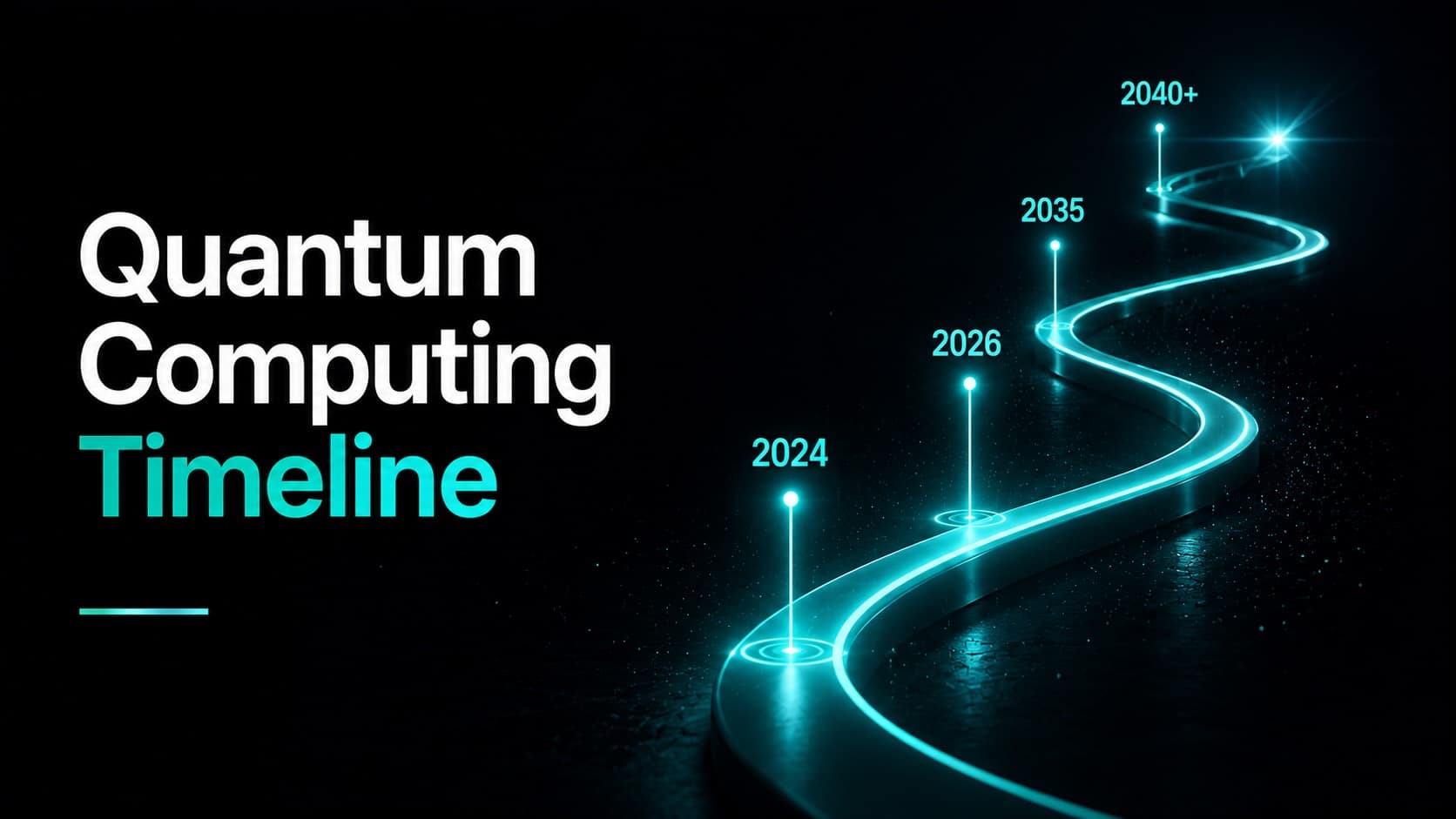
Security planning for quantum threats has always rested on a simple assumption: there is a large gap between the quantum hardware that exists today and the hardware needed to break production cryptography. That gap is real. But the critical question — how fast is it closing — has received a deeply uncomfortable answer in 2026. The quantum computing timeline has compressed by roughly two orders of magnitude in seven years, driven by a combination of algorithmic improvements, architectural breakthroughs, and hardware advances that have each progressively lowered the bar for what counts as a cryptographically capable quantum computer.
Understanding why this happened, what it means for blockchain security today, and what the global standards and technology community is doing in response is no longer optional for anyone making architectural decisions about systems that need to remain secure for the next decade.
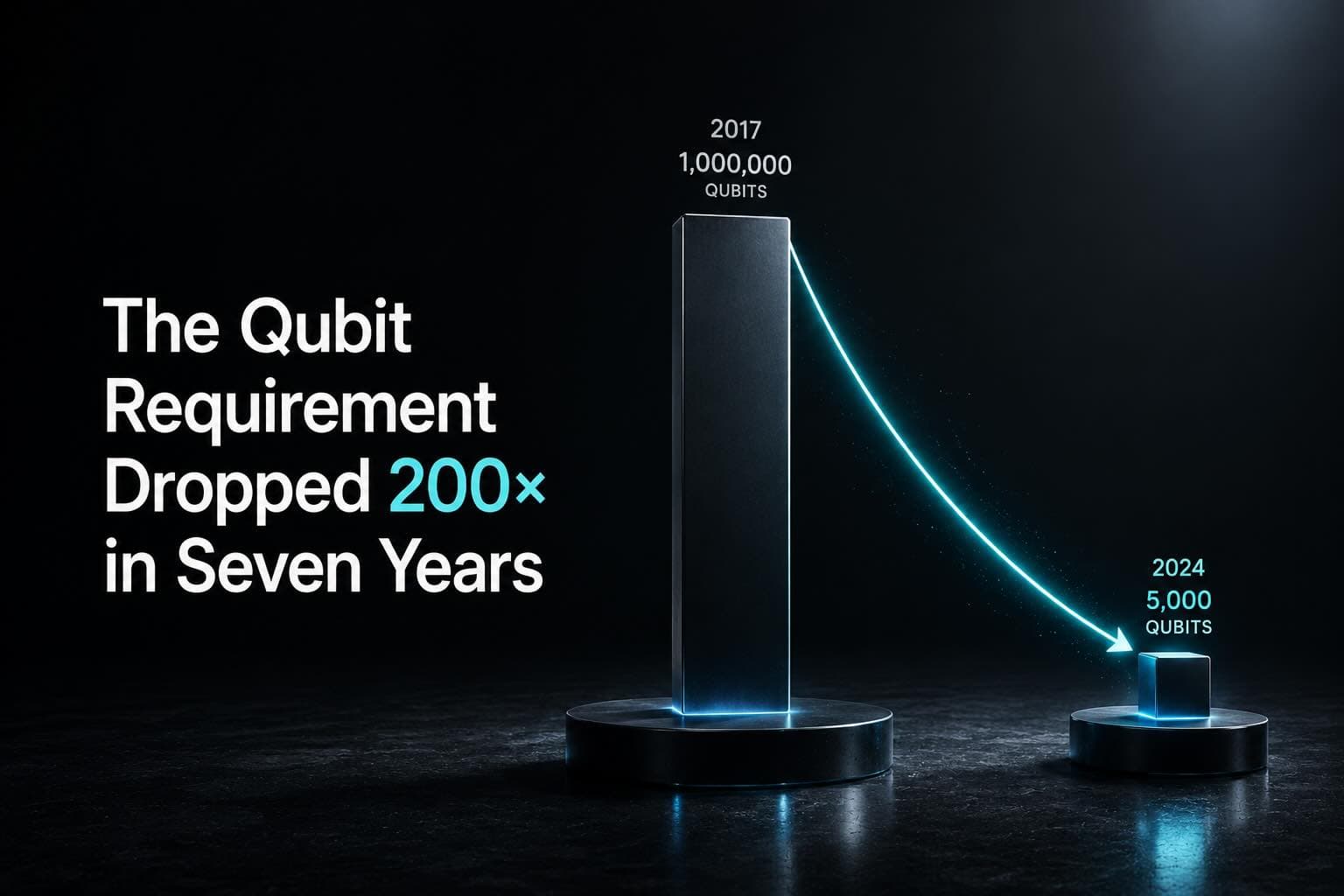
The 200× Compression: Where the Estimates Started and Where They Are Now
The benchmark that researchers use for "cryptographically relevant" quantum capability is the ability to factor large integers or solve discrete logarithm problems at production key sizes — the operations underpinning RSA, Diffie-Hellman, and the elliptic-curve cryptography used by Bitcoin and Ethereum. The resource requirement for this computation — measured in physical qubits — has been revised substantially downward with each generation of research.
In 2019, the leading estimate placed the physical qubit requirement for breaking RSA-2048 at approximately 20 million qubits. This number was already a significant reduction from earlier, cruder estimates, and it placed a meaningful gap between the hardware of 2019 (a few dozen qubits at best) and the hardware needed to pose a real cryptographic threat. The message to the security community was: you have time.
By 2025, improvements in quantum error correction — particularly the development of more efficient codes that require fewer physical qubits per logical qubit — had driven that estimate down to under one million qubits. Still a long way from existing hardware, but the gap had narrowed by a factor of twenty in six years.
In early 2026, Google's Quantum AI team published updated analysis incorporating quantum low-density parity-check (QLDPC) codes — a more efficient error correction architecture that had matured significantly from theoretical proposals to practical implementations. The result: breaking the elliptic-curve cryptography protecting Bitcoin and Ethereum wallets may require fewer than 500,000 physical qubits, roughly twenty times fewer than leading estimates from just a few years prior.
Separately, research from a Caltech-Berkeley collaboration exploring neutral atom quantum systems — which have demonstrated control over thousands of qubits in laboratory settings — suggests that with architectural optimisations specific to atomic qubit platforms, Shor's algorithm might operate with as few as 10,000 to 26,000 qubits to crack Bitcoin's secp256k1 elliptic curve, albeit over a computation window measured in days rather than hours. The specific qubit count depends heavily on the error rate, correction overhead, and algorithm variant, but even the most conservative interpretation represents a dramatic reduction from 2019 baselines.
The trajectory is consistent across every methodology: each new generation of research reduces the estimated qubit requirement by a factor of ten to twenty. The gap between present hardware and dangerous hardware is shrinking not linearly but in steps, and 2026 represents a significant step.
Where Hardware Actually Stands in 2026
The revised qubit estimates matter only in context of actual hardware progress. The picture here is more nuanced than either optimistic or pessimistic framings suggest.
IBM unveiled a 120-qubit chip in late 2025, targeting demonstrations of quantum advantage on specific problem classes. IBM's stated roadmap aims for fault-tolerant systems — the kind capable of sustained, error-corrected computation — by 2029. Google's own hardware timeline, also targeting fault tolerance around the same period, aligns with this. These are not vague aspirations; they are roadmap commitments from two of the largest quantum hardware programmes in the world, backed by substantial capital investment and published research on specific milestones.
In the neutral-atom space, companies including Quantinuum and several well-funded startups have demonstrated laboratory control over thousands of physical atomic qubits. Neutral-atom systems are particularly relevant to the revised qubit estimates because the QLDPC codes that drive those estimates are architecturally well-suited to neutral-atom implementations. The specific number of qubits needed to run a cryptographically relevant attack using neutral atoms, with current published error rates, remains higher than what exists today — but the architectural pathway from existing demonstrations to dangerous capability is now clearly visible.
The summary: no quantum computer today can attack production elliptic-curve cryptography. But the hardware trajectory and the revised algorithmic estimates are converging in a way that makes the mid-2030s a credible window for first capability — with some scenarios placing first-possible attacks earlier, in the late 2020s, if hardware progress continues at or above current rates and algorithmic improvements continue.
The Regulatory Response: 2026 Is Already a Compliance Year
Governments and standards bodies have been watching the same trajectory, and the regulatory response has accelerated significantly in the past two years. What was once a theoretical planning concern has become a concrete compliance requirement in multiple jurisdictions.
The most significant milestone was August 2024, when the US National Institute of Standards and Technology published its first three finalised post-quantum cryptographic standards: ML-KEM (for key encapsulation, based on Module-LWE), ML-DSA (for digital signatures, the standardised form of CRYSTALS-Dilithium), and SLH-DSA (for hash-based signatures, the standardised form of SPHINCS+). These are not draft proposals or experimental algorithms. They are published FIPS standards, which means US federal agencies and federally regulated industries are now obligated to begin migration planning.
In March 2025, NIST selected HQC (Hamming Quasi-Cyclic), a code-based algorithm, as a backup key encapsulation mechanism — insurance against the possibility that lattice-based schemes turn out to have unexpected weaknesses. The selection of a backup standard signals how seriously NIST treats the risk of any single mathematical assumption failing.
The NSA's Commercial National Security Algorithm Suite 2.0 (CNSA 2.0) sets a hard deadline: from January 2027, all new national security systems must use quantum-safe algorithms. This is not a recommendation. It is a mandate for the most sensitive systems in the US government, and it sets a benchmark that affects every technology vendor with government contracts.
NIST's broader guidance recommends phasing out quantum-vulnerable algorithms — RSA, ECDSA, Diffie-Hellman — after 2030, and disallowing their use entirely after 2035. For systems being designed in 2026, this timeline means that any deployment with a planned lifespan beyond 2030 should already be incorporating post-quantum algorithms or at minimum designing for easy migration.
The Private Sector Has Already Started Moving
The regulatory pressure is being matched by voluntary adoption among major technology companies, driven partly by liability considerations and partly by genuine engineering foresight.
Apple integrated post-quantum cryptography into iMessage in 2024, making it the first consumer messaging platform to deploy PQC at scale. The implementation uses ML-KEM for key establishment, providing what Apple describes as security against both classical and quantum attacks on message confidentiality. For a service used by over a billion people, this is not a research experiment — it is production deployment.
Cloudflare, which handles a significant fraction of global internet traffic, reported that by late 2025 the majority of human-generated web traffic flowing through its network was protected by post-quantum key exchange. The company has set a target of full post-quantum coverage by 2029. Google similarly announced a 2029 internal deadline for post-quantum migration across its infrastructure.
These organisations have made their timelines public not because they believe Q-Day is imminent, but because the harvest now, decrypt later threat makes waiting economically irrational for any system protecting long-lived sensitive data. Communications encrypted today against a 2031 quantum adversary should be protected with algorithms that can resist that adversary — and transitioning takes years.
The Harvest Now Problem Gets Worse as the Timeline Compresses
The most underappreciated implication of the timeline compression is its effect on harvest now, decrypt later risk. When Q-Day was estimated to be twenty or thirty years away, the practical relevance of data collected today was limited — most information has a shelf life shorter than three decades. But as the plausible Q-Day window moves to the mid-2030s, the calculus changes for a much larger category of data.
Financial account information, healthcare records, long-term contractual agreements, intellectual property, and — critically — blockchain wallet credentials all have value horizons that extend into the 2030s. An adversary who archives Bitcoin transaction data today and operates a capable quantum computer in 2034 can retroactively derive the private keys for every wallet that ever exposed its public key. Those funds do not disappear when Q-Day arrives. They transfer — instantly and irrecoverably — to whoever runs the first capable machine.
The compression from a 2040s threat to a 2030s threat matters not just for timeline planning but for data collection. The shorter the gap, the more recent data is worth harvesting. Adversaries with long time horizons — nation-states, well-capitalised criminal organisations — update their harvest-and-wait strategies in response to exactly this kind of research. A 200× reduction in estimated resource requirements is not academic; it changes the economics of what is worth archiving right now.
What the Timeline Means for Blockchain Architecture Decisions Today
For developers, protocol designers, and infrastructure operators making decisions in 2026, the timeline compression changes the frame of reference for what "adequate preparation" looks like.
A blockchain built today with ECDSA signatures and no post-quantum migration plan is not just a theoretical risk — it is a system whose cryptographic foundation has a visible expiry date within the planning horizon of the infrastructure being built. The NIST guidance to phase out quantum-vulnerable algorithms post-2030 applies to general-purpose systems. Blockchain, with its immutable historical record and permanent address exposure, faces a more acute version of the same problem.
The appropriate response depends on where you sit. For existing protocols, the answer is to accelerate whatever migration roadmap exists, prioritise the BLS aggregation problem for Ethereum, implement key-hiding proposals like BIP-360 for Bitcoin sooner rather than later, and begin the difficult governance conversations about what happens to unmigrated wallets before Q-Day makes the discussion urgent.
For new infrastructure, the answer is more fundamental: the right time to build quantum resistance into a blockchain is before genesis, not after. The architectural choice to never expose public keys on-chain — the foundation of QuanChain's TADEQS system — is not possible as a retrofit on a network with a sixteen-year history of transactions. It is only possible as a first-principles design decision.
The Quantum Oracle that powers QuanChain's automatic security level adjustment is similarly a consequence of building from scratch rather than retrofitting. A network designed around the insight that quantum threat levels change over time — and that the architecture should respond to those changes automatically — is categorically different from one that treats post-quantum cryptography as a one-time upgrade.
The 200× compression in qubit estimates from 2019 to 2026 is not a reason for panic. It is a reason for accurate calibration. The window for making good architectural decisions about post-quantum security is not closed. But it is no longer as wide as it was seven years ago, and it is narrowing faster than most security planning assumes.
Frequently Asked Questions
How many physical qubits does it take to break Bitcoin's encryption in 2026?
The most recent estimates, incorporating QLDPC error correction architecture, suggest that breaking Bitcoin's secp256k1 elliptic-curve cryptography may require fewer than 500,000 physical qubits using near-term hardware. Separate neutral-atom research suggests the number could be as low as 10,000 to 26,000 qubits under specific architectural conditions, with the computation taking days rather than hours. No existing system reaches these qubit counts at the required error rates, but the trajectory of hardware development makes this a mid-decade rather than end-of-century engineering challenge.
What NIST post-quantum standards are final as of 2026?
NIST has published three finalised post-quantum cryptographic standards: ML-KEM (Module Lattice-based Key Encapsulation Mechanism, formerly CRYSTALS-Kyber, FIPS 203), ML-DSA (Module Lattice-based Digital Signature Algorithm, formerly CRYSTALS-Dilithium, FIPS 204), and SLH-DSA (Stateless Hash-based Digital Signature Algorithm, formerly SPHINCS+, FIPS 205). A fourth algorithm, FN-DSA (formerly FALCON), was in final stages as of late 2025. Additionally, HQC, a code-based key encapsulation mechanism, was selected in March 2025 as a backup KEM standard.
When does the US government require post-quantum cryptography?
The NSA's CNSA 2.0 framework requires all new national security systems to use quantum-safe algorithms from January 2027. NIST's broader guidance recommends phasing out quantum-vulnerable algorithms after 2030 and disallowing them entirely after 2035. A US Executive Order from June 2025 directed all federal agencies to begin post-quantum migration planning immediately. For organisations building systems in 2026, any deployment with a lifespan past 2030 should already be incorporating post-quantum algorithms into its design.
Why do the qubit estimates keep changing so dramatically?
The estimates change because quantum error correction research keeps finding more efficient ways to implement logical qubits using fewer physical qubits. Each generation of error-correcting codes — from early surface codes through to the QLDPC codes driving 2026's estimates — reduces the physical-to-logical qubit overhead. Additionally, algorithm optimisations for running Shor's algorithm on specific architectures reduce the number of logical operations required, which further reduces the physical qubit count. Neither the hardware requirements nor the algorithmic requirements are fixed targets — they are active research areas moving in the direction of lower cost and fewer resources.